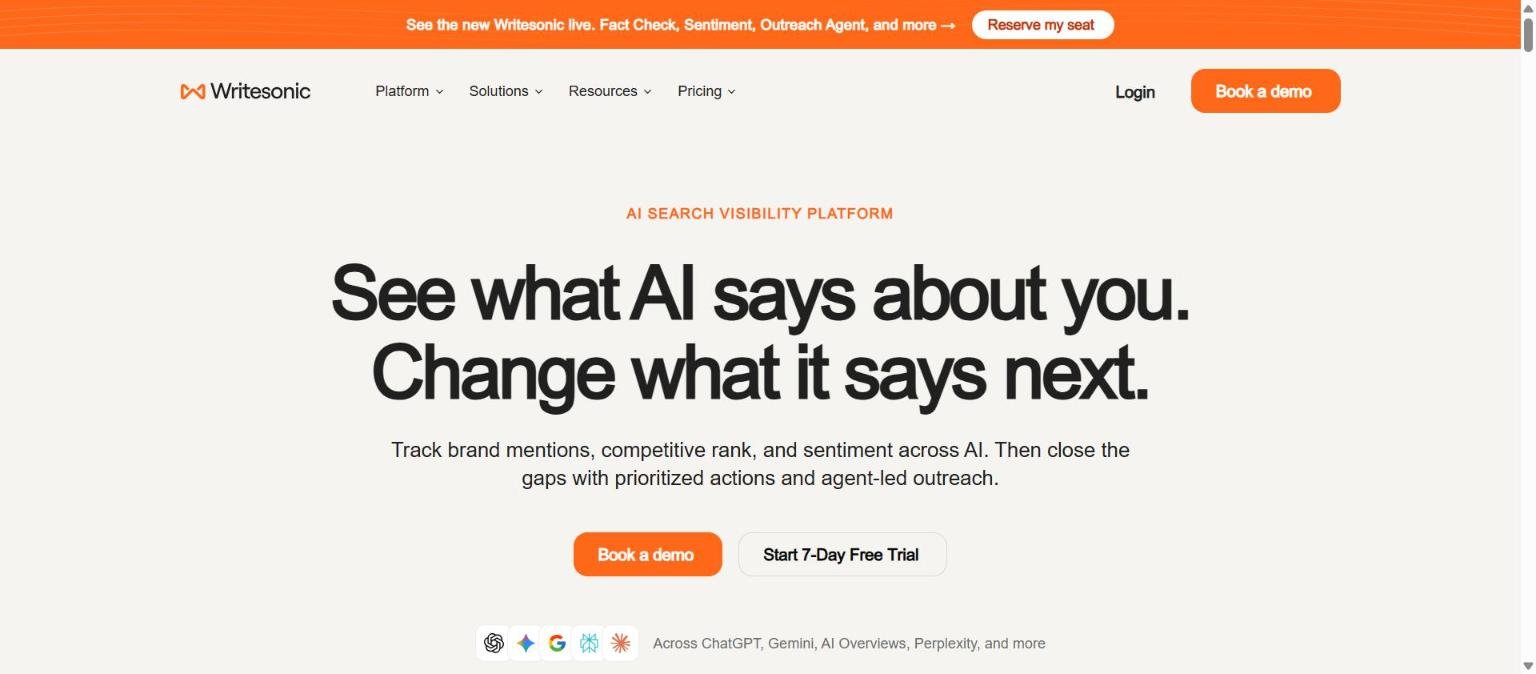
Writesonic used to be known mainly as an AI writing tool for blog posts and ad copy. Its current homepage tells a different story. It now calls itself an “AI search visibility platform for GEO and AEO”, with the headline “See what AI says about you. Change what it says next.” Most of what it sells is tracking and improving how your brand appears in answers from AI systems.
That change matters if you remember Writesonic from older reviews or comparison lists. This guide profiles the product as its own pages describe it today: what it does, who it is for, the features and plans it lists, strengths, limits and what it says about security. We could not read a dedicated privacy policy or trust page, so those parts are limited. A note on the premise: if you are searching for a simple AI article writer, read the pricing section carefully, because article writing is now one feature inside a visibility platform.
How we researched this: we did not run hands-on tests for this article. It is based on the vendor’s own documentation and public sources, checked on 14 November 2026. Features and prices change, so confirm details on the vendor’s site before you buy.
Key takeaways
- Writesonic describes itself as an AI search visibility platform for Generative Engine Optimization (GEO) and Answer Engine Optimization (AEO): it tracks brand mentions, competitive rank and sentiment across AI platforms.
- The pricing page lists Starter at $79 per month, Basic at $199 and Growth at $399, all billed annually, and a custom Enterprise plan. We checked on 14 November 2026.
- Plan limits are expressed as prompts tracked daily, AI articles per month, site audits and agentic runs, with a fair usage policy.
- The homepage claims SOC 2 Type II, GDPR and HIPAA compliance, hosting on Microsoft Azure, 10,000-plus marketing teams and 4.8 ratings on G2 and Capterra. These are vendor claims. The pricing page lists the compliance items under Enterprise.
- Some homepage statistics looked like placeholders, so verify any dataset figures directly with the vendor.
What it is and who makes it
Writesonic is a platform for monitoring and improving how brands show up in AI-generated answers. The homepage lays out the core product. It lets you enter a brand, topic or industry, and it runs prompts daily, either recommended by Writesonic or chosen by you, then reports brand mentions, competitive rank and sentiment across AI platforms.
Two terms need explaining. GEO (generative engine optimisation) and AEO (answer engine optimisation) are names for the practice of making your content more likely to be cited or recommended in answers from AI systems such as chat assistants and AI search features. If you want the background on how those systems answer questions, see what is a large language model and our update on AI search and answer engines.
The homepage names the platforms it tracks as ChatGPT, Gemini, Google AI Overviews, Perplexity and Claude, shows logos for Grok, DeepSeek and Meta AI, and claims coverage of 8 AI platforms in 50-plus markets and 50-plus languages. Which platforms you get depends on your plan: Starter, Basic and Growth track ChatGPT, Gemini and Google AI Overviews, while Enterprise tracks all 8.
The vendor presents the product as a loop: see where you stand, find the gaps, fix them with agents, and measure the result.
Who it is for
- Marketing and SEO teams who worry about AI answers. If customers ask chat assistants for recommendations in your category, you may want to know whether you appear.
- Agencies reporting on AI visibility. Plans list projects and users, with Starter at 1 user and 1 project and Growth at 3 users and 2 projects.
- Content teams who want fixes, not just charts. The Action Center lists recommended fixes, and an AI agent rewrites pages.
- Enterprises. The Enterprise plan lists all 8 platforms, custom prompts, regions and languages, SSO and a dedicated AI search strategist.
It is a poor fit if you simply need a cheap tool to draft occasional blog posts. The entry plan is $79 per month on annual billing and is built around monitoring, so a general assistant such as ChatGPT or Claude will usually cost less for plain drafting. It also does not replace a traditional SEO suite. For that, see our Surfer SEO review.
Consider timing as well. If your category is rarely discussed in AI assistants, a visibility platform may report little to act on, and the money may do more good elsewhere. If buyers in your market already ask assistants for shortlists, the case for monitoring is stronger.
Core features
Visibility tracking
Monitors brand mentions, competitive rank and sentiment across AI platforms. It runs prompts daily, recommended by Writesonic or chosen by the user. The pricing page lists daily prompts and answers tracked: 50 and 150 on Starter, 100 and 300 on Basic, 200 and 600 on Growth.
Research dataset
The homepage describes searching an AI conversation dataset it says covers 2 billion-plus conversations, updated weekly, for comparing brands and spotting prompt trends. The statistics section looked like placeholder values, so verify the figure with the vendor.
Action Center
Ranks recommended fixes by visibility and citation impact, such as missing prompts, citation gaps, content refreshes and technical issues. Growth has a limited trial of 5 off-page and 5 on-page actions per month, and the full Action Center is on Enterprise.
Execution agents
An AI agent rewrites pages with FAQ blocks, comparison tables and self-contained passages. An outreach agent helps find and draft contact with sites, such as Reddit threads and listicles, that cite competitors.
Site audit
Reviews robots.txt, schema, indexing and broken pages, and surfaces errors from AI crawlers such as GPTBot, ClaudeBot and PerplexityBot. Some fixes can be applied with one click.
Content creation
Includes an article writer and a content agent. Plans list AI articles per month: 15 on Starter, 25 on Basic and 50 on Growth.
Measurement
Tracks results at Day 14 and Day 28 across citation share, AI traffic, conversions and pipeline.
Newer and advanced features and integrations
Sentiment analysis and fact checking
The homepage highlights Sentiment Analysis and Fact Check in a banner announcing a live event, but does not describe them in detail. The pricing page lists Sentiment Analysis from the Growth plan and Fact Check on Enterprise.
Outreach Agent, Citation Decay and Social Citations
Enterprise lists the Outreach Agent, Citation Decay and Social Citations (YouTube, LinkedIn and Reddit). The pages we read do not explain Citation Decay, so we only repeat the name.
Integrations
The homepage lists Google Analytics, Google Search Console, Looker Studio, Google Keyword Planner, WordPress, APIs and MCP. On the pricing page, Looker Studio integration is listed under Enterprise, so check which integrations your plan includes.
Agentic runs
Plans list “agentic runs”: 10 trial runs on Starter, 50 on Basic, 100 on Growth and full access on Enterprise. A fair usage policy applies.
Why trial runs matter
The word “trial” on the lower plans suggests that agent features are partly sampled there. If agents are the reason you want the product, check carefully what a trial run covers before you buy.
How to test a visibility platform
Because AI answers change from prompt to prompt, run your own baseline before you trust any dashboard. Pick fifteen prompts a customer might type, ask each one in the assistants you care about, and record whether your brand appears, which sources are cited and which competitors are named. Do it again a week later. Then compare your notes with what the platform reports for the same prompts. If the numbers are broadly consistent, the tool is measuring something real. If they differ widely, ask the vendor how prompts are run and how often.
Pricing and plans
Checked on 14 November 2026. Starter, Basic and Growth are priced per month billed annually. The page has a monthly and annual toggle, but the monthly-billed prices were not shown in the text we read.
| Plan | Price (billed annually) | Prompts and answers tracked daily | AI articles per month | Site audits | Agentic runs | Users and projects |
|---|---|---|---|---|---|---|
| Starter | $79 per month | 50 and 150 | 15 | 10 audits of up to 100 pages each | 10 trial runs | 1 user, 1 project |
| Basic | $199 per month | 100 and 300 | 25 | 20 audits of up to 1,200 pages each | 50 trial runs | 2 users, 1 project |
| Growth (marked most popular) | $399 per month | 200 and 600 | 50 | 50 audits of up to 2,500 pages each | 100 trial runs | 3 users, 2 projects |
| Enterprise | Custom, book a demo | Custom | Custom | Custom | Full access | Custom |
The three lower plans track ChatGPT, Gemini and Google AI Overviews, plus ads monitoring and site audits with automatic AI fixes. Sentiment Analysis and Action Center are not included on Starter and Basic, and Growth adds Sentiment Analysis and a limited Action Center trial. Enterprise tracks all 8 platforms with custom prompts, regions and languages, a full Action Center, Outreach Agent, Fact Check, Citation Decay, Social Citations, Looker Studio integration, SSO and SAML, a dedicated AI search strategist, and lists SOC 2 Type II, HIPAA and GDPR compliance. Support runs from standard email on Starter and Basic to priority email on Growth and dedicated channels on Enterprise. A fair usage policy applies.
Notice that Perplexity and Claude are named on the homepage as tracked platforms, but the pricing page lists only ChatGPT, Gemini and Google AI Overviews on the lower plans. Confirm which platforms your plan covers. For help reading a table like this, see how to read an AI tool’s pricing page.
Strengths
Focused on a real new problem
Knowing whether AI answers mention your brand is a question many marketers now ask, and the product is built around it rather than adding it as a side feature.
From monitoring to action
The platform pairs tracking with an Action Center, page rewriting and outreach, so findings can become tasks.
Specific limits on the pricing page
Prompts, articles, audits, agentic runs, users and projects are listed with numbers, which makes plans easier to compare.
Site audit with AI crawler errors
Surfacing errors from crawlers such as GPTBot, ClaudeBot and PerplexityBot addresses a technical gap that traditional audits may miss.
Listed compliance on Enterprise
The pricing page lists SOC 2 Type II, HIPAA and GDPR for Enterprise, which procurement teams will want to verify.
Weaknesses and limits
The product has changed direction
If you remember Writesonic as a general AI writer, note that the current homepage centres on AI search visibility. Older reviews may describe a different product.
Entry price is business-level
Starter is $79 per month on annual billing, which is much higher than many general writing tools.
Key features sit on higher plans
Sentiment Analysis starts at Growth, and the full Action Center, Outreach Agent and Fact Check are Enterprise features. The lower plans have trial runs of agents.
Placeholder-looking statistics and vendor claims
The homepage statistics looked like placeholders, and claims such as 10,000-plus teams, a 4.8 rating on G2 and Capterra, named customers and a $350K-plus deal in a testimonial are vendor-presented and not verified by us.
Platform coverage differs by plan
Only Enterprise tracks all 8 platforms. Check that the platforms your customers use are on your plan.
The field is new and measurement is hard
AI answers vary by prompt, region and time. Treat visibility numbers as indicators, and cross-check with other sources. See AI agents: what is real and what is hype for a sober view of agent claims.
Privacy, data handling and security
We could not read a dedicated privacy policy or trust page for Writesonic. These are the statements on the homepage and pricing page.
- The homepage claims SOC 2 Type II, GDPR compliance, HIPAA compliance and single sign-on, and states that the platform is hosted on Microsoft Azure.
- The pricing page lists SOC 2 Type II, HIPAA and GDPR under Enterprise, and SSO and SAML with custom user and access controls.
- We could not confirm how prompts, site data or connected accounts (such as Google Analytics and Search Console) are stored, retained or used for any model training.
This tool connects to your analytics and your website, so review the permissions you grant and ask for a data processing agreement if you handle personal data. For an internal policy baseline, see how to protect company data when using AI tools.
How it compares
The table compares Writesonic with three other tools from the 50-tool list that overlap on content or search work. It documents differences on official pages and does not rank them.
| Aspect | Writesonic | Jasper | Surfer SEO | ChatGPT |
|---|---|---|---|---|
| Main job today | AI search visibility tracking and fixes (GEO and AEO) | Marketing content and campaigns with brand context | Search content optimisation (see our shorter review) | General assistant |
| Entry price on official page | Starter $79 per month (annual billing) | Pro $59 per seat per month (annual billing) | See our older Surfer SEO review | Not readable on the page we fetched |
| GEO or AEO features | Core product | GEO agents and tracking on Business, with credits | Not covered here | Not a tracking tool |
| Enterprise route | Custom, with compliance list | Business, custom | See vendor | Business and Enterprise |
See our full guide to Jasper for the marketing platform angle, and ChatGPT for general drafting.
| If you need | Consider | Reason |
|---|---|---|
| Tracking mentions across AI platforms | Writesonic | Core product |
| Brand-consistent campaign content | Jasper | Brand IQ and agents |
| Occasional drafts at low cost | A general assistant | Cheaper for plain drafting |
Getting started
- Write down the ten questions customers might ask an AI assistant about your category.
- Book the demo or start the 7-day free trial the homepage offers, and check what the trial includes.
- Add your brand, competitors and prompts, and note which platforms are covered.
- Compare the tool’s results with what you see when you ask the same questions yourself.
- Look at the recommended actions and decide which you can act on in a month.
- Ask for security documents and data terms before connecting analytics accounts.
Frequently asked questions
What is Writesonic now?
An AI search visibility platform for GEO and AEO, according to its homepage. It also includes an article writer and a content agent.
What do GEO and AEO mean?
Generative engine optimisation and answer engine optimisation, the practice of improving how often AI systems cite or recommend your content.
How much does Writesonic cost?
The pricing page listed Starter at $79, Basic at $199 and Growth at $399 per month billed annually, and Enterprise as custom, on 14 November 2026.
Is there a free trial?
The homepage offers a 7-day free trial. Check what it includes.
Which AI platforms does it track?
The homepage names ChatGPT, Gemini, Google AI Overviews, Perplexity and Claude and claims 8 platforms. The lower plans list ChatGPT, Gemini and Google AI Overviews.
Is it compliant with SOC 2 and GDPR?
The vendor claims SOC 2 Type II, GDPR and HIPAA compliance. Ask for the documents to verify.
Can I use it only as an article writer?
It includes an article writer, with a monthly article count on each plan, but the platform is built around visibility, so check whether the price makes sense for that use.
Does this replace a traditional SEO tool?
The pages we read describe AI visibility, site audits and content tools, but not a full traditional SEO suite. Treat it as an addition and compare it with your current search tools.
Conclusion
Writesonic has moved from AI writing toward AI search visibility. If you want to know how often AI systems mention your brand, which competitors they recommend and what to fix, it is a purpose-built option with clearly listed plan limits. If you only want a low-cost drafting tool, the current entry price and focus make it a poor match.
Test with real prompts, compare results with your own checks, and verify the vendor claims and data terms before connecting your analytics. For method, see how to choose an AI tool and how to test an AI tool before you pay for it.
Sources
- Writesonic homepage, accessed 14 November 2026
- Writesonic pricing page, accessed 14 November 2026