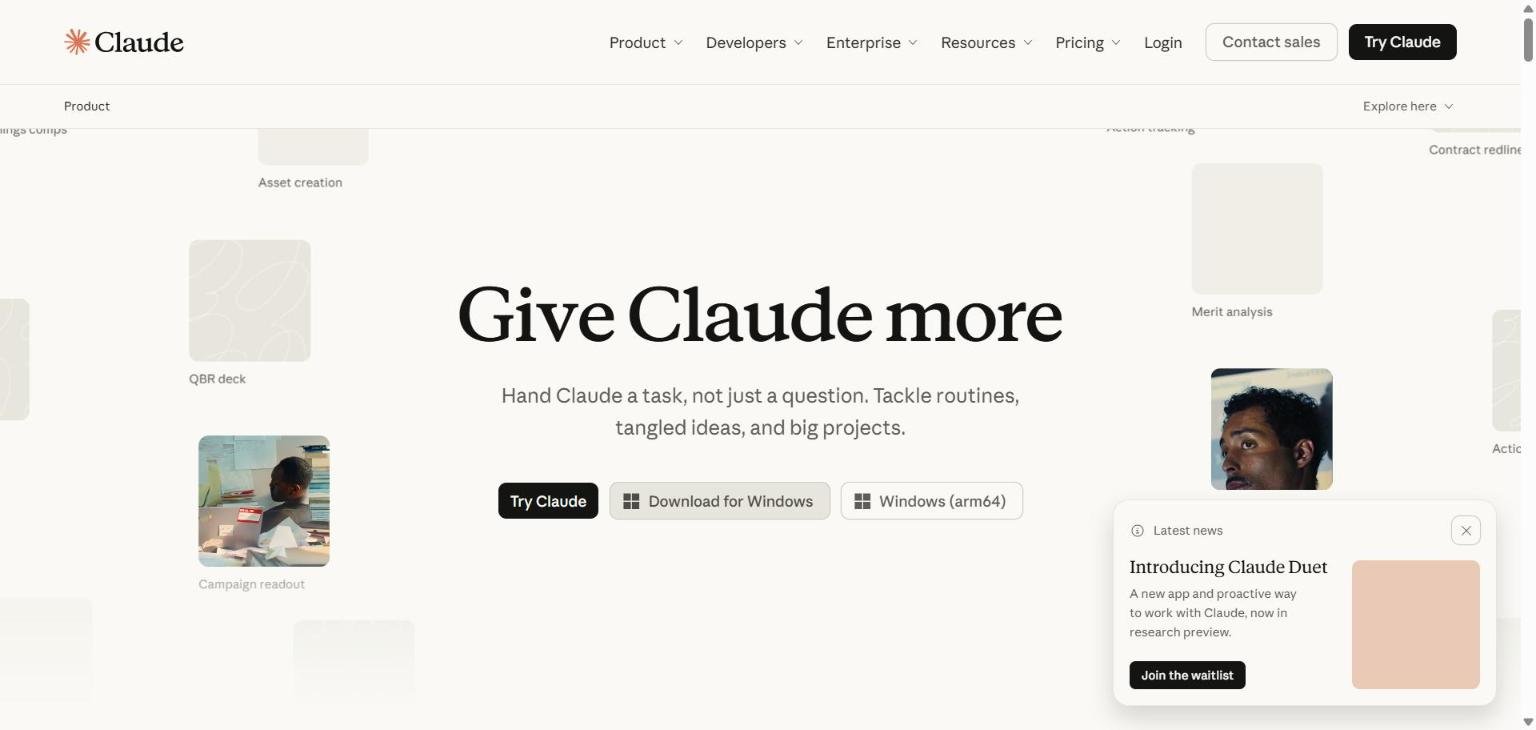
Claude is the AI assistant made by Anthropic. It started as a chat assistant and, according to the vendor’s current product page, it now spans a chat app, a coding product, a collaborative work agent called Cowork, browser and office extensions, and a developer platform. The headline on the page reads “Give Claude more”, with the line “Hand Claude a task, not just a question”.
This guide profiles Claude from public documentation: what it is, who it suits, its documented features, how plans are structured, strengths, limits, and what Anthropic says about data. Anthropic is also the company behind the model that wrote parts of the tooling around this site, so we have been especially careful to use only what the official pages state. If you want a shorter read, see our shorter review.
How we researched this: we did not run hands-on tests for this article. It is based on the vendor’s own documentation and public sources, checked on 14 November 2026. Features and prices change, so confirm details on the vendor’s site before you buy.
Key takeaways
- Claude is made by Anthropic PBC and is available on the web, desktop and mobile. The product page also lists Claude Code, Cowork, Claude in Chrome, and extensions for Google Workspace and Microsoft 365.
- The pricing page lists Free, Pro, Max and Ultra for individuals, Team seats for 2 to 150 people, and Enterprise. We read the figures on 14 November 2026 and quote them below with that date.
- Usage limits are not fixed message counts. The page says they depend on the model, conversation length and file size.
- Anthropic’s privacy page for consumer plans does not say chats are used for training by default. It lists when chats may be used and points to a Model Improvement setting.
- Always check important outputs. See how to check AI output for mistakes.
What it is and who makes it
Claude is a family of AI models and the assistant built on them. The footer of the official product page names Anthropic PBC as the maker. The assistant is available on the web, on desktop and on mobile, and the page says Claude Cowork and chat are now integrated within Claude.ai.
The product page lists several products. Claude is the assistant itself. Claude Code is the coding product. Claude Cowork is the collaborative work agent. Claude Duet is described as a new app for proactive work, in research preview with a waitlist. Claude Tag works with Claude directly in Slack and is in beta for Team and Enterprise plans. Claude Security and Claude Science are listed as specialised products, and Claude Platform is the API for developers, with Managed Agents. The page also names extensions: Claude in Chrome, Claude for Google Workspace and Claude for Microsoft 365.
The model families listed are Mythos (including Fable), Opus, Sonnet and Haiku. For a primer on what these models are, see what is a large language model.
Who it is for
Anthropic’s own plan structure shows who it is aimed at.
- Individuals. The Free plan covers chat, web search, file creation, code execution, memory, Artifacts and up to 5 projects. Pro, Max and Ultra add usage and features for heavier users.
- Developers. Claude Code is included on paid individual plans (the Free plan page says no Claude Code access), and Claude Platform serves API users.
- Small and mid-sized teams. The Team plan is for 2 to 150 seats, with SSO, central billing, usage analytics and a statement that content is not used for model training by default.
- Larger organisations. Enterprise adds admin spend limits, role-based access, SCIM, audit logs, a Compliance API, custom data retention, IP allowlisting and a HIPAA-ready offering.
- People working in Microsoft 365 or Google Workspace. Dedicated extensions are listed.
It is less suited to anyone who needs a guaranteed fixed message count, since the page explains limits are not fixed counts.
Core features
Chat with files and web search
The Free plan page lists web, desktop and mobile chat, web search, file creation and code execution. The product page lists web search for current information under access tools.
Artifacts
The product page describes Artifacts as shareable designs, slides and documents, plus interactive visuals. Artifacts are included on the Free plan.
Projects, memory and instructions
Memory, Projects and “Instructions for Claude” are listed as ways to keep context across conversations. The Free plan allows up to 5 projects, and Pro is listed with unlimited projects.
Connectors, plugins and skills
Connectors link apps such as Gmail, Slack and Salesforce, and can be browsed in a marketplace. Plugins and Skills extend what Claude can do and teach repeatable workflows.
Voice, scheduled and parallel tasks
The product page lists voice, scheduled tasks and parallel tasks. It does not give limits, so check your plan.
Files, folders, browser and computer use
Files and folders, browser use and computer use (listed as beta) let Claude work beyond a chat box. Treat anything that acts on your behalf with caution and review permissions.
Research
The Pro plan is listed with Research. The product page does not describe a feature by that name, and the closest match it gives is web search, so we cannot describe its method.
Newer and advanced features and integrations
Claude Code and Cowork
Claude Code is listed on Pro and above, and in Team plans. Cowork is described as part of Claude.ai and is included in Team plans. If coding is your main use, compare with Cursor and GitHub Copilot using your own repository.
Claude in Chrome and office extensions
Claude in Chrome is listed on Pro. Claude for Microsoft 365 is also listed on Pro, and Claude for Google Workspace appears on the product page. The pages do not detail what each extension can do in this text, so check the extension listings.
Claude Duet and Claude Tag
Claude Duet is a research preview with a waitlist, and Claude Tag is in beta for Team and Enterprise. Preview and beta features can change or be withdrawn, so do not build critical workflows on them yet.
Claude Platform and Managed Agents
For developers, Claude Platform is the API, with Managed Agents. Max and Ultra plans include monthly Claude Platform API credits according to the pricing page ($100 and $200 per month respectively). The Enterprise plan charges usage at API rates.
Claude Security
The Enterprise plan lists Claude Security as a beta item. The pages we read give no more detail.
Pricing and plans
Checked on 14 November 2026. The official pricing page shows the following. It shows a dollar sign and does not name the currency for most plans, though it labels the Enterprise price “US$”. Confirm the figure for your region before you buy.
| Plan | Price on the page | Notes from the page |
|---|---|---|
| Free | $0 | Usage limited every 5 hours and every week; chat, web search, file creation, code execution, memory, Artifacts, up to 5 projects; no Claude Code or Opus access |
| Pro | $17 per month on annual billing ($200 up front) or $20 per month billed monthly | More usage than Free, Claude Code, unlimited projects, Opus, Research, Claude in Chrome, Claude for Microsoft 365, usage credits |
| Max | $100 per month | 5x Pro usage every 5 hours and every week, $100 per month in Claude Platform API credits, early access, priority access at busy times |
| Ultra | $200 per month | 10x Pro usage every week, no 5-hour limit for verified accounts, $200 per month in API credits, everything in Max |
| Team Standard seat | $20 per seat per month billed annually, or $25 monthly | 2 to 150 seats; more usage than Pro; SSO, central billing, usage analytics |
| Team Premium seat | $100 per seat per month billed annually, or $125 monthly | 5x the usage of a Standard seat |
| Enterprise | $20 per seat per month billed annually, 20-seat minimum, plus usage at API rates | Admin spend limits, SCIM, audit logs, Compliance API, custom retention, IP allowlisting, HIPAA-ready offering; sales-assisted option adds invoicing and AWS Marketplace |
The page says usage limits are not fixed message counts and depend on the model, conversation length and file size. Team plans include up to $500 per month in pooled API credits, and the page says Team does not include SCIM, audit logs, the Compliance API or the HIPAA-ready offering. Mixed seat types are allowed. Our guide to reading an AI pricing page explains why these details matter.
Strengths
A clear plan ladder with usage multipliers
Max is described as 5x Pro usage and Ultra as 10x Pro weekly usage. Even without fixed message counts, the multipliers let you reason about relative headroom.
Work-oriented features in one place
Artifacts, Projects, connectors, skills, scheduled tasks and extensions are documented together, so a person can move from a chat to a shared file or a recurring task without leaving the product.
Team plan terms on training
The Team plan description includes no model training on your content by default, which is stated on the pricing page as part of the plan.
Strong admin features at the top tier
Enterprise lists SCIM, audit logs, a Compliance API, custom data retention and IP allowlisting, which matter to security reviews.
Coding is a first-class product
Claude Code is a named product with developer documentation, and it is included on paid plans.
Weaknesses and limits
Limits are relative, not fixed
Because the page says limits depend on model, conversation length and file size, you cannot predict exactly how much work a plan covers. Heavy users should test with real tasks.
Many products and names
The product page lists Claude, Cowork, Duet, Tag, Security, Science, Platform and several extensions. New buyers can find it hard to know which product they need, and some are previews or betas.
No Claude Code or Opus on Free
The Free plan lists no Claude Code or Opus access, so the strongest features sit behind payment.
Currency is not always named
The page shows a dollar sign without naming the currency for most plans. Check your local price.
Team plan lacks some governance features
The page says Team does not include SCIM, audit logs, the Compliance API or a HIPAA-ready offering, so regulated teams need Enterprise.
Outputs can be wrong
As with any language model, review important answers. See AI hallucinations: what they are and how to reduce them.
Privacy, data handling and security
Only what Anthropic’s official pages state is repeated here.
- Consumer plans (Free, Pro, Max). The privacy page does not say chats are used for training by default. It lists three cases when chats may be used to improve models: when you choose to allow it, when a conversation is flagged for safety review, and when you explicitly opt in, such as through a Trusted Tester Program. It points to a Model Improvement setting in Privacy Settings.
- Incognito chats. The page says these are not used for improvement, even if Model Improvement is enabled.
- Feedback. When you give a thumbs up or down, the whole related conversation is stored for up to 5 years, de-linked from your user ID before use, and may be used for training.
- Retention. The only period stated on that page is the 5 years for feedback. We could not confirm a general chat retention period from it.
- Commercial products. The page says Claude for Work and the API are covered in a separate article we did not read. The pricing page states that Team plans do not use content for model training by default.
For policy ideas, read how to protect company data when using AI tools.
How it compares
The table compares Claude with three other assistants from the 50-tool list, based only on vendor pages. It shows differences, not a ranking. For a testing method, see ChatGPT vs Claude vs Gemini: how to compare assistants.
| Aspect | Claude | ChatGPT | Gemini | Perplexity |
|---|---|---|---|---|
| Maker | Anthropic | OpenAI | Perplexity (we could not read its own company page) | |
| Entry plan | Free, with limits every 5 hours and weekly | Free, with limited features | Free with a Google Account | Free tier listed by a secondary source |
| Individual paid plan names | Pro, Max, Ultra | Go, Plus, Pro | Google AI Plus, Pro, Ultra | Pro and Max per a secondary source |
| Coding product | Claude Code | Codex | Antigravity | Not a focus |
| Work files | Artifacts, Cowork | Work experience | Canvas | Spaces and documents per secondary source |
Our older ChatGPT review and Gemini review give shorter takes on two of these.
| If you value | Look at | Reason from vendor pages |
|---|---|---|
| Admin controls and audit logs | Claude Enterprise | SCIM, audit logs, Compliance API listed |
| Office app integration | Claude, Microsoft Copilot | Extensions for Microsoft 365 listed for Claude; Copilot is native to Microsoft apps |
| Sourced search answers | Perplexity | Positioned around cited answers per secondary reporting |
| A very low entry price | Compare Free tiers | All offer a free entry point; test them on your own tasks |
Getting started
- Sign up for the Free plan on the web or install the desktop or mobile app.
- Open Privacy Settings and review the Model Improvement setting before entering sensitive text.
- Create a project for one recurring task and add instructions and files.
- Try one connector, such as Gmail or Slack, only after reviewing the permissions it asks for.
- If you hit limits, compare Pro on the vendor page with the work you actually do.
- For a team, review Team versus Enterprise governance features before buying seats.
Frequently asked questions
Who makes Claude?
Anthropic PBC, according to the product page footer.
Is Claude free?
Yes, there is a Free plan at $0 with usage limits every 5 hours and every week.
How much is Claude Pro?
The pricing page showed $17 per month on annual billing ($200 billed up front) or $20 per month billed monthly when we checked on 14 November 2026.
Does Claude train on my chats?
For consumer plans, Anthropic’s page does not say chats are used for training by default, and lists when they may be used. Team plans state no model training on your content by default. Read the current policy and your settings.
What is the difference between Max and Ultra?
Max is $100 per month with 5x Pro usage. Ultra is $200 per month with 10x Pro weekly usage and no 5-hour limit for verified accounts, according to the pricing page.
Does Claude have a coding tool?
Yes. Claude Code is listed on Pro and above.
What is Claude Duet?
A new app for proactive work, in research preview with a waitlist, per the product page.
Conclusion
Claude is documented as a work-focused assistant with chat, Artifacts, Projects, connectors, a coding product and office extensions, sold through a ladder from Free to Ultra plus Team and Enterprise. Its strengths are the clear plan structure, team and admin features, and a published stance on consumer data. Its cautions are relative usage limits, a crowded product list that includes previews and betas, and the usual need to verify outputs.
Start on Free with real tasks, read the privacy settings, and upgrade for a documented reason. For method, see how to choose an AI tool and how to test an AI tool before you pay for it.
Sources
- Claude product overview (Anthropic), accessed 14 November 2026
- Claude pricing (Anthropic), accessed 14 November 2026
- Is my data used for model training (Anthropic Privacy Center), accessed 14 November 2026