Ideogram is an AI image generation company best known for putting readable text inside images, and its homepage now describes it as a maker of open models for visual intelligence. It offers a web app with a free tier, paid personal and team plans, an enterprise route with custom models, and developer access. Its latest models are shown on the homepage as Ideogram 4.0 and 4.5.
This guide collects what Ideogram’s own pricing page, privacy policy and homepage say, adds clearly labelled third-party reporting on the open-weight 4.0 release, and compares the tool with three others on our list. Our separate comparison of Leonardo, Ideogram and Recraft is a good companion if you are shortlisting.
How we researched this: we did not run hands-on tests for this article. It is based on the vendor’s own documentation and public sources, checked on 14 November 2026. Features and prices change, so confirm details on the vendor’s site before you buy.
Key takeaways
- Ideogram’s homepage positions its models around prompt fidelity, crystal-clear type and reliable editing.
- The pricing page we read lists Free, Plus ($15 a month), Pro ($42 a month shown, with a struck-through $60), Team ($20 per user) and Enterprise (contact sales) tiers.
- Private generation is listed on the Pro plan. The privacy policy says generated images are publicly available on the services, so check how your plan handles visibility.
- Ideogram’s FAQ says it does not claim ownership of your generated images, and that they can be used for any purpose, including commercial use.
- Third-party coverage reports an open-weight Ideogram 4.0 release in June 2026 with a non-commercial weights licence. We cite it as reported, not as verified.
What it is and who makes it
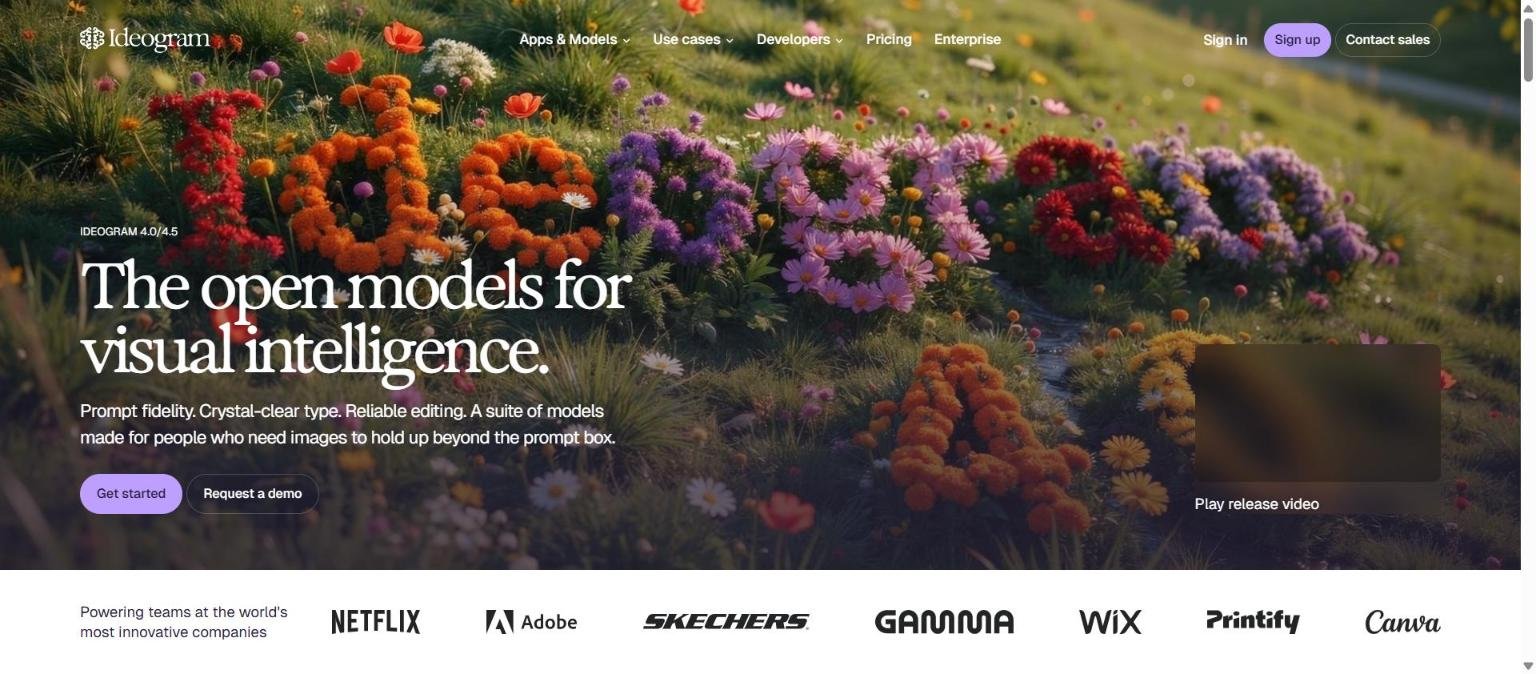
Ideogram is the product of a company of the same name that builds image generation models. The homepage we viewed shows a label for Ideogram 4.0/4.5 and the headline that these are the open models for visual intelligence. The supporting copy lists prompt fidelity, crystal-clear type and reliable editing, and describes a suite of models made for people who need images to hold up beyond the prompt box.
The page navigation has Apps and Models, Use cases, Developers, Pricing and Enterprise menus, with Sign in, Sign up and Contact sales buttons and a Request a demo option. Under the hero, the page shows logos of companies it says it powers, including Netflix, Adobe, Skechers, Gamma, Wix, Printify and Canva. Those are the vendor’s own marketing claims, and we have not verified any of the relationships.
Typography as the headline strength
Image generators have long struggled to render legible words. Ideogram’s own copy makes type a central promise, which is why designers who need posters, logos, social graphics or packaging mock-ups with text often put it on a shortlist. We have not tested how well it does this, so treat the claim as the vendor’s.
Apps, models and developers
The navigation separates Apps and Models from Developers. In practice that means there is a consumer-facing web app, a set of models, and a route for developers and enterprises. The pricing page mentions API volume discounts only under Enterprise and a default rate limit of 10 in-flight requests.
Who it is for
From the documented positioning and plans, Ideogram suits the following groups.
- Designers and marketers who need text in images, such as social posts, posters and mock-ups, and who want to test the vendor’s claims on their own prompts.
- Hobbyists and small creators who can use the free tier or the low-priced Plus plan.
- Teams that want central billing and administration, which the Team plan lists, with a minimum of two users.
- Enterprises that want private custom models trained on their own visual data, which the Enterprise tier lists.
- Developers who want to build image generation into products using the API.
It is a weaker fit for people who want video, audio and a full editing suite in the same product, or who need confidentiality on a low-cost plan. Use our guide to choosing an AI tool to test your requirements before you subscribe.
Core features
Prompt-based image generation
The core of the product is generating images from text prompts. The homepage language about prompt fidelity indicates that the models aim to follow instructions closely. We did not read model documentation, so we cannot describe the controls in detail.
Text rendering
Typography is the most prominent feature on the homepage. Third-party coverage of the open-weight Ideogram 4.0 model describes a structured way of specifying text, with the words, font, weight, size and colour set separately, and a vendor-reported OCR accuracy figure that the article says has not been independently verified. Because this comes from a developer blog, not Ideogram’s documentation, we do not repeat the figure.
Editing
The homepage names reliable editing as a headline capability. The pricing page does not itemise editing tools, and several parts of the page showed placeholders when we read it, so check the live page for what each plan includes.
Character consistency and batch generation
The Pro plan on the pricing page lists unlimited character consistency and batch generation, along with quality export and the largest generation queue. These are the most specific feature claims on the page.
Community gallery
Pro is listed with community gallery access. Combined with the privacy policy statement that generated images are publicly available, the gallery is a defining part of how the service works.
Newer or advanced features and integrations
Open-weight Ideogram 4.0 (third-party reporting)
A developer article we read says Ideogram 4.0 was released on 3 June 2026 as the company’s first open-weight model with 9.3 billion parameters, and that the model was trained on structured captions. A second article says the inference code is under the Apache 2.0 licence while the weights fall under a non-commercial agreement, so commercial use needs a separate paid arrangement. It also reports hosted API pricing tiers and distribution through partner platforms, including ComfyUI, Leonardo AI and Picsart. These are reports from outside sites. We could not open an Ideogram page that confirms the licence terms, so read the official model page before relying on them.
Version 4.5
The homepage label shows 4.0/4.5, which indicates a 4.5 release. We did not find an official description of what changed in 4.5, so we do not describe it.
API and rate limits
The pricing page says the default API rate limit is 10 in-flight requests, and that volume API discounts are an Enterprise feature billed separately.
Private custom models
Enterprise is listed with private custom models trained on your visual data. This matters for brands that want a consistent look without exposing their assets, but details need a sales conversation.
Pricing and plans
The table below reflects Ideogram’s pricing page as read on 14 November 2026. Prices are in US dollars. Parts of the page showed loading placeholders, so some figures may be incomplete. Confirm everything on the live page.
| Plan | Price shown | Credits | Features listed |
|---|---|---|---|
| Free | $0 | Weekly slow credits for eligible accounts, no priority amount shown | None itemised |
| Plus | $15 a month | 1,000 priority credits a month, unlimited slow credits | Not itemised on the page |
| Pro | $42 a month, shown against a struck-through $60. $504 billed annually | 3,500 credits a month, 3,500 priority credits | Private generation, unlimited slow credits, unlimited character consistency, batch generation, quality export, largest generation queue, community gallery access, $4 priority top-ups |
| Team | $20 per user a month billed annually, shown against a struck-through $30 | 1,500 credits per user a month, 1,500 priority credits | Central billing and administration, collaboration features, largest queue, $4 priority top-ups. Minimum 2 users |
| Enterprise | Contact us | Custom | Private custom models trained on your visual data, volume API discounts billed separately, priority support |
Priority and slow credits
The page describes two kinds of credit. Priority credits are used for faster generation, while slow credits are used with a lower priority. Plus and Pro both list unlimited slow credits. Our guide to reading an AI tool’s pricing page explains why a mix of credit types makes cost estimates harder.
Discount pricing
Several prices appear with struck-through higher figures. These may be promotions or standard monthly versus annual differences, and the page does not say. Confirm what you will actually pay at checkout.
Strengths
A clear focus on typography
Few image tools lead their homepage with type quality. If your work involves text inside images, a focused tool is easier to evaluate than a general generator.
A free tier and an inexpensive Plus plan
The pricing page lists a free plan with weekly slow credits and a $15 plan with 1,000 priority credits, so the entry cost is low compared with some competitors.
Ownership statement
The FAQ on the pricing page says Ideogram does not claim ownership of your generated images and that you can use them for any purpose, including commercial use. This is a plain, helpful statement, although copyright law on AI output is still developing. See our overview of AI copyright cases.
Team and enterprise options
A per-user Team plan with central billing and an enterprise path with private custom models give organisations room to grow.
Open model direction
The homepage’s open-models framing, plus third-party reports of open weights, appeals to developers who want to run or study models themselves. The licence details need checking.
Weaknesses and limits
Public by default
The privacy policy says that when you generate an image, it is publicly available on the services alongside identifying details such as your account handle and picture, and that others may store, display, reproduce or publish it. Private generation is listed on the Pro plan. Anyone on a lower plan should assume their images may be public.
Thin feature detail on the pricing page
The page does not itemise features for Free and Plus, and it did not mention tools such as canvas editing or specific prompt helpers. We could not confirm what each plan includes beyond credits.
No video or audio in what we read
The pages we read describe images. We saw no video or audio features, so teams that want one tool for several media types should check elsewhere.
Complex credit system
Priority, slow and top-up credits, plus per-user credits on Team, take some effort to work out. Run a trial to see how many credits a useful result takes.
Open-weight licence caveats
If the reports are right that the weights are licensed for non-commercial use, businesses should not assume they can run the model commercially without a separate agreement.
Privacy, data handling and security
This section reflects Ideogram’s privacy policy, which we read on 14 November 2026. It showed a last revised date of 15 January 2025, so check for newer versions.
| Topic | What the privacy policy says |
|---|---|
| Public display | Generated images are publicly available on the services alongside details such as your account handle and picture. Others may store, display, reproduce or publish them. |
| Model training | The policy lists training the models that power the services as a use of information collected from other sources, and says user input is used to improve and develop products and technology, based on legitimate interest. It does not specifically address generated images in this context. |
| Retention | Information is kept for as long as is reasonably necessary. No fixed period is stated. |
| Location | Information may be processed outside your country of residence. |
| Children | The services are not intended for children. The policy does not state a minimum age. |
| Ownership | The pricing FAQ says Ideogram does not claim ownership of your generated images. |
For client work, use a plan with private generation and read the current terms of service. We also recommend our checklist on protecting company data when using AI tools.
How it compares
The table compares Ideogram with three other tools on our list, using each vendor’s own pages as read on 14 November 2026. We have not tested any of them. See also our quarterly roundup of AI image tools.
| Tool | Positioning on its own pages | Entry pricing we could confirm | Visibility and privacy note |
|---|---|---|---|
| Ideogram | Open models for visual intelligence, with typography as a headline | Free, then $15 a month Plus | Images publicly available per policy, private generation listed on Pro |
| Midjourney | Community-funded research lab building AI models | $10 a month Basic, no free plan on its plans page | Public by default, stealth mode on Pro and Mega |
| Leonardo.Ai | The creator-first generative AI platform | Consumer pricing not confirmed by us | Terms not read by us |
| Adobe Firefly | Images, video and audio in one studio | Free tier with limited daily generations | States it does not train Firefly on customer content |
Getting started
- Open the Ideogram homepage and read the Pricing page, noting that the table may show promotional prices.
- Sign up for the free plan and generate a few images that include text you actually need.
- Check where your images appear and whether your plan lets you generate privately.
- If you need private generation, character consistency or batch generation, compare Pro against your expected volume.
- Read the privacy policy and terms before uploading client material.
- For commercial work, keep a record of prompts and settings and review each output carefully.
Frequently asked questions
Is Ideogram free?
The pricing page lists a Free plan at $0 with weekly slow credits for eligible accounts. It does not show a priority credit amount for the free tier.
Are my Ideogram images private?
Not necessarily. The privacy policy says generated images are publicly available on the services, and the pricing page lists private generation on the Pro plan. Check how your own plan behaves.
Can I use Ideogram images commercially?
The pricing FAQ says Ideogram does not claim ownership of your generated images and that you can use them for any purpose, including commercial use. This is general information, not legal advice, and you should read the current terms.
Is Ideogram open source?
The homepage calls its offering open models. Third-party coverage says the 4.0 model has open weights under a non-commercial agreement. We could not confirm the licence on an official page, so check before relying on it.
What is the difference between priority and slow credits?
The pricing page lists priority credits as a monthly amount, and unlimited slow credits on Plus and Pro. It does not explain the speed difference in detail, so test it on the free plan.
Does Ideogram have an API?
The navigation includes a Developers menu, and the pricing page mentions API volume discounts for Enterprise and a default rate limit of 10 in-flight requests.
Conclusion
Ideogram is a focused image generation service with a strong emphasis on legible text, a low-priced entry plan and a path to team and enterprise use. The main points to weigh are the public display of generated images unless you use private generation, the thin feature detail on the plans page and the licence questions around open weights.
It suits designers and marketers who need text in images and who are comfortable with the visibility settings. For a decision method, use our guide to choosing an AI tool, and compare it with its rivals in our three-way comparison.
Sources
- Ideogram homepage, viewed 14 November 2026
- Ideogram pricing, accessed 14 November 2026
- Ideogram privacy policy, accessed 14 November 2026
- DEV Community: Ideogram 4 was trained on JSON, accessed 14 November 2026 (third party)
- Noqta: Ideogram 4 open-weight image model, accessed 14 November 2026 (third party)