ElevenLabs is best known as a voice generator, but its own site now describes something wider: a platform with a no-code web app for creators, a builder for voice agents, and an API for developers. Text to speech is still the core, and around it sit speech to text, dubbing, music, sound effects, voice cloning and more.
This guide pulls together what ElevenLabs documents about itself: the products, the models, the plans and the limits. It is a researched profile rather than a test report, so you will find named features, dated prices and plain notes on what we could not confirm. If you want a shorter read first, see our shorter review.
How we researched this: we did not run hands-on tests for this article. It is based on the vendor’s own documentation and public sources, checked on 11 November 2026. Features and prices change, so confirm details on the vendor’s site before you buy.
Key takeaways
- ElevenLabs groups its offer into ElevenCreative (a web app), ElevenAgents (voice agents) and ElevenAPI (developer access), plus an AI receptionist product called Reception.ai.
- Its documentation lists text to speech models covering from 29 to 90+ languages, a speech to text family called Scribe, dubbing, music generation and a voice library of 10,000+ voices.
- On the pricing page we read on 14 November 2026, plans run from a free tier with 10k credits a month to a Business tier at $990 a month, with custom Enterprise terms above that.
- Commercial use, professional voice cloning and some quality options sit behind paid tiers, and free-tier dubs are watermarked, so check the plan before you plan a project.
- Several documented features are labelled alpha, experimental or in maintenance mode, so treat those as moving targets rather than settled tools.
What ElevenLabs is and who makes it
ElevenLabs is the company behind a family of AI voice products. Its documentation describes four main surfaces. ElevenCreative is a no-code web app for generating voiceovers, music, dubs and studio projects in the browser. ElevenAgents is a platform for building voice agents, with a visual builder for non-technical users and programmatic control for developers. ElevenAPI is a REST interface to all capabilities, with official Python and TypeScript SDKs and a command line tool. Reception.ai is an AI phone receptionist aimed at small and medium businesses, which the docs say answers calls, books appointments and manages daily operations.
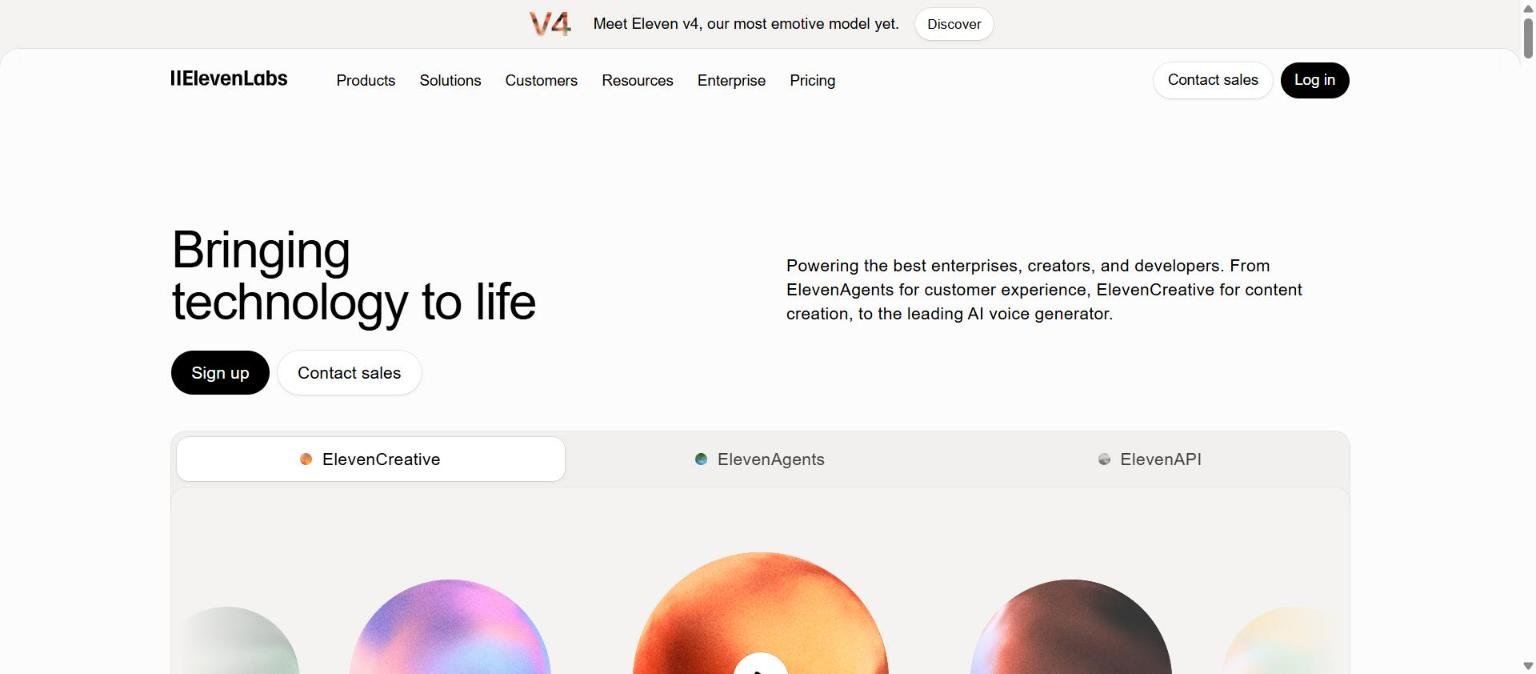
The homepage we captured on 14 November 2026 carries the headline “Bringing technology to life” and describes the offer as powering enterprises, creators and developers, from ElevenAgents for customer experience to ElevenCreative for content creation. A banner advertises Eleven v4, described as the company’s most emotive model yet, and a news item on the homepage refers to a company summit in New York on 11 November 2026. We did not read the full announcement, so we do not summarise it here.
This article covers the product as documented, not the company’s history or funding. We could not confirm company size, headcount or user numbers from the official pages we read, so we leave them out.
| Surface | What the documentation says it is | Typical user |
|---|---|---|
| ElevenCreative | No-code web app for voiceovers, music, dubs and studio projects | Creators, marketers, video and audio teams |
| ElevenAgents | Platform for building voice agents with a visual builder and programmatic control | Support, product and engineering teams |
| ElevenAPI | REST interface with Python and TypeScript SDKs and a CLI | Developers building voice features into apps |
| Reception.ai | AI phone receptionist for small and medium businesses | Small businesses that take calls and bookings |
Who ElevenLabs is for
ElevenLabs suits people who need spoken audio at volume or at a quality bar that a basic text to speech voice does not meet. That includes video makers who want narration, publishers turning text into audio, teams that need translated versions of existing video, and developers building voice interfaces. The documentation names use cases such as ad narration, multilingual audiobooks and real-time streaming audio.
It also suits teams with compliance needs, with a caveat. Enterprise plans are documented as including custom terms, data processing agreements, service level assurances, business associate agreements for HIPAA customers, single sign-on and elevated concurrency limits. Data residency in the EU, India or Singapore is described as an Enterprise feature. If you fall under those requirements, you will be talking to sales rather than buying a self-serve plan.
People who should look elsewhere include anyone who only needs a handful of short clips with no commercial use, where the free tier may be enough, and anyone who needs live dubbing, which the dubbing documentation lists as not available. Writers looking for a general chatbot are in the wrong category entirely.
| If you are… | ElevenLabs may fit because… | Watch out for… |
|---|---|---|
| A solo creator | Free and low-cost tiers exist, and a voice library of 10,000+ voices is documented | Commercial rights start at the Starter tier; free dubs are watermarked |
| A video or podcast team | Dubbing keeps background audio and up to 32 speakers per file are supported | Dubbing v2 is described as alpha; Studio is in maintenance mode |
| A developer | Official SDKs, a CLI and models tuned for low latency | Per-model character limits and concurrency caps |
| An enterprise buyer | SSO, audit logs, data residency options and custom terms are documented | Key controls are Enterprise only and priced by contract |
Core features
Text to speech with a choice of models
Text to speech is the foundation. The documentation lists six models. Eleven v4 is described as the most expressive, with 90+ languages and a 10,000 character limit per request. Eleven v4 Turbo is built for real-time use at about 100 ms median latency with 90+ languages and audio tags. Eleven v3 covers 70+ languages with a 5,000 character limit. Multilingual v2 covers 29 languages and is described as the most stable for long-form audio. Flash v2.5 is the lowest-cost option, with 32 languages and a 40,000 character limit.
Voice library, cloning and design
The voice library holds 10,000+ voices shared by the community. Instant voice cloning builds a voice from short samples, documented as under two minutes of audio. Professional voice cloning uses extended training audio for higher fidelity, and the docs state that a Creator plan or above is required. A voice captcha step is described as confirming that professional clones come from your own samples.
Speech to text with Scribe
Scribe is the speech to text family. Scribe v3 handles recorded audio, Scribe v3 Live handles real-time audio over WebSockets, and Scribe v2 Medical is tuned for clinical audio. The documentation claims 90+ languages and lists word-level timestamps, speaker diarization for up to 32 speakers, keyterm prompting, entity detection and optional removal of filler words.
Dubbing
Dubbing translates audio and video into 90+ languages while keeping each speaker’s timing, tone and voice characteristics, and it keeps the original background audio. Sources can be YouTube or TikTok links, direct URLs or uploads. Automatic Dubbing (Dubbing v2) is the app default but is labelled alpha. Dubbing Studio, which adds transcript editing and per-clip regeneration, is in maintenance mode and receives critical fixes only.
Music, sound effects and more
Eleven Music generates tracks from natural language prompts, with vocals or instrumentals, section-level regeneration and finetunes trained on tracks you own. The page says it was created with labels, publishers and artists and is cleared for nearly all commercial uses, with supported usage varying by plan. Tracks run from 3 seconds to 5 minutes. Sound effects, a voice changer, a voice isolator, forced alignment and text to dialogue are also listed as capabilities.
Newer and advanced features and integrations
ElevenAgents for voice agents
ElevenAgents is the platform for building conversational voice agents, with a visual builder for non-technical users and programmatic control for developers. Eleven v3 Conversational is listed as a real-time speech model at about 165 ms median latency. We could not open the dedicated agents documentation during this research, so we do not describe telephony options, tool calling or supported language models in detail.
Private deployment and data residency
For enterprises, the documentation describes private deployments that run agents, text to speech and speech to text in the customer’s own cloud, plus data residency in the EU, India or Singapore. Workspaces support SSO using SAML 2.0 or OIDC and audit logs. The speech to text docs note that experimental transcript editing is not available in data residency environments, which is a reminder that some features differ by region.
SDKs, CLI and integrations
ElevenAPI ships official Python and TypeScript SDKs and a CLI. The homepage and docs we read did not give a full integrations list, so we cannot say which third-party tools connect natively. If an integration matters, check the current docs before committing.
Startup grants
The pricing page describes a startup grants program for building conversational AI agents, listed as 12 months free with 33M characters. Eligibility rules were not on the page we read, so confirm them with the vendor.
Pricing and plans
ElevenLabs sells self-serve plans measured in credits, with an Enterprise tier on custom terms. The table below is what we read on the official pricing page on 14 November 2026, in US dollars as shown on the page. Prices exclude taxes and duties, and the page shows monthly and yearly billing toggles without listing yearly prices in the content we could read. Prices and limits change often, so confirm everything on the vendor page. For a method of reading these pages, see how to read an AI tool’s pricing page.
| Plan | Price (checked 14 Nov 2026) | Credits per month | Notable inclusions listed |
|---|---|---|---|
| Free | $0 a month | 10k | Text to speech, speech to text, sound effects, voice design, music; limited to 3 Studio projects |
| Starter | $1 first month, then $6 a month | 30k | Commercial license, instant voice cloning, 20 Studio projects, Dubbing Studio |
| Creator | $11 first month, then $22 a month | 121k | Professional voice cloning, extra credits |
| Pro | $99 a month | 600k | 44.1kHz PCM output via API, 192kbps audio quality |
| Scale | $299 a month | 1.8M | 3 seats, team collaboration, 3 professional voice clones |
| Business | $990 a month | 6M | 10 seats, low-latency text to speech, 10 professional voice clones |
| Enterprise | Custom | Custom | Custom terms, DPA and SLA assurances, BAAs for HIPAA customers, custom SSO, managed dubbing |
Two practical points follow from the table. First, credits are the unit, so the same plan produces very different amounts of audio depending on model and feature. The page we read also showed approximate minute equivalents and overage rates, but we parsed those with uncertainty and do not reproduce them here. Second, introductory prices for Starter and Creator apply to the first month only, so budget for the standard rate.
For a fair trial, follow how to test an AI tool before you pay for it and use the free tier on your real scripts first.
Strengths
Breadth under one account
Few voice tools cover text to speech, transcription, dubbing, music and agents together. For a team that produces video, podcasts and localised content, one vendor and one credit pool can simplify procurement, although you should check whether the credit costs of each feature suit your mix.
Model choice for different jobs
The documented model lineup separates quality, stability, cost and latency. Choosing Flash v2.5 for cheap, fast output and Multilingual v2 for stable long-form narration is a concrete way to trade cost against polish, and the docs explain which is which.
Documented limits and honest caveats
The documentation names its own rough edges, such as alpha status for Dubbing v2, preview-only dubbed video and the mono audio of v1. That candour makes planning easier than vendor pages that only list highlights.
Voice control and consent step
Professional voice cloning is gated to Creator and above and uses a voice captcha to check that samples are your own. For anyone worried about misuse of cloning, that is a documented safeguard worth noting, though it is not a guarantee against abuse.
Enterprise options
Private cloud deployment, regional data residency, SSO, audit logs, BAAs and zero retention mode for covered enterprise API endpoints are all described. For regulated buyers this is a genuine differentiator, provided your contract confirms the details.
Weaknesses and limits
Credits make costs hard to forecast
Plans are measured in credits rather than finished minutes or songs, and different models and features consume credits differently. You need to run real material through a free or low plan to learn your true cost per finished minute.
Alpha, experimental and maintenance labels
Dubbing v2 is labelled alpha, transcript editing is experimental and Dubbing Studio is in maintenance mode. If you build a workflow on those, expect changes. The docs also say default voices expire on 31 December 2026 and Music v1 will be removed on 31 January 2027, so deprecations are a live issue.
Quality varies by language
The speech to text docs group languages by word error rate, from 5 percent or lower to 25 to 50 percent for some lower-resource languages. Text to speech and dubbing quality will also depend on language and voice, so test your target languages specifically.
No live dubbing
The dubbing documentation lists realtime or live dubbing as not available. If you need live interpretation for events, this is not the tool as documented.
Higher tiers need a budget
Professional voice cloning needs Creator or above, seats and several clones sit at Scale and Business, and the strongest compliance features are Enterprise only. Small teams may find the useful features spread across several price points.
Privacy, data handling and security
We could not open ElevenLabs’ privacy policy or security page during this research, so we do not describe its general data handling, retention or training practices. Read them directly before you upload voices or confidential scripts. What the documentation we did read states is limited to the following.
Enterprise customers can get data residency in the EU, India or Singapore, private deployments in their own cloud, SSO, audit logs and a zero retention mode for covered enterprise API endpoints. The speech to text documentation says HIPAA-regulated customers must contact sales for a business associate agreement before deployment. The text to speech documentation says commercial use requires a paid plan and that you retain ownership of the generated audio. Copyright screening applies to tracks uploaded as audio references or finetune training material in the music feature.
If you handle personal voices, customer calls or medical audio, our guide on how to protect company data when using AI tools lists the contract questions to ask.
How ElevenLabs compares
The tools below are three alternatives from our 50-tool list that overlap with parts of ElevenLabs. The table compares documented positioning only. We did not test any of them, and each has strengths outside this overlap. For a head-to-head on voiceover tools, see ElevenLabs vs Murf vs PlayHT.
| Tool | Overlap with ElevenLabs | Documented difference | Pricing model we read |
|---|---|---|---|
| ElevenLabs | Text to speech, cloning, dubbing, speech to text, music, agents | Wide platform with six TTS models and an API-first option | Credits; free to $990 a month plus Enterprise (14 Nov 2026) |
| Murf | Text to speech voiceovers, API, dubbing | Murf homepage describes a voice platform with a studio, a TTS API and conversational agents | Creator $19 and Business $66 a month billed annually (14 Nov 2026) |
| Descript | AI voice, voice clones, translation | Primarily a text-based video and audio editor with AI voice features | Free, Hobbyist, Creator, Business and Enterprise tiers (14 Nov 2026) |
| Otter.ai | Transcription | Meeting notetaker focused on transcripts and summaries, not voice generation | Basic free, Pro, Business and Enterprise tiers (14 Nov 2026) |
In short, choose ElevenLabs when the voice itself is the product and you want model and API control. Choose a text-based editor such as Descript when editing the video is the main job, and a meeting notetaker such as Otter.ai when the need is notes from live calls. For a fair way to compare, see how to compare AI tools side by side fairly and our roundup AI voice tools: what changed this year.
Getting started
This is a cautious path based on the documented free tier. Adjust it to your needs.
- Open the pricing page and note the free tier limits: 10k credits a month and a cap of 3 Studio projects.
- Take one real script of about a minute and generate it with two models, for example Flash v2.5 and Multilingual v2, to compare cost and sound.
- Check how many credits each run used, then estimate your monthly volume before choosing a paid plan.
- If you need commercial use, remember it starts at a paid plan, and check the license terms for your use case.
- Before cloning any voice, confirm you have the speaker’s consent and read the voice cloning terms.
- If you handle sensitive audio, read the privacy policy and ask sales about zero retention and data residency.
Frequently asked questions
Is ElevenLabs free?
There is a free tier at $0 a month with 10k credits, according to the pricing page we read on 14 November 2026. It covers text to speech, speech to text, sound effects, voice design and music, limited to 3 Studio projects, and the documentation says commercial use requires a paid plan.
Can I use ElevenLabs audio commercially?
The text to speech documentation states that commercial use requires a paid plan and that you retain ownership of generated audio. The Starter plan lists a commercial license. For music, usage varies by plan, so read the music terms.
How many languages does it support?
It depends on the model. Multilingual v2 supports 29 languages, Flash v2.5 supports 32, Eleven v3 supports 70+, and Eleven v4 and v4 Turbo support 90+. Scribe speech to text and dubbing both claim 90+ languages.
Can it clone my voice?
Yes. Instant voice cloning works from short samples, and professional voice cloning, which needs a Creator plan or above, uses longer training audio and a voice captcha check. Only professional clones can be shared publicly in the library.
Does ElevenLabs offer live dubbing?
No. The dubbing documentation lists realtime or live dubbing as not available. It offers automatic dubbing of uploaded or linked files, with Dubbing v2 labelled alpha.
Is there an API?
Yes. ElevenAPI is a REST interface with official Python and TypeScript SDKs and a CLI. Rate and concurrency limits vary by plan, for example up to 3 concurrent dubbing jobs on self-serve plans.
How does it handle my data?
We could not read the privacy policy during this research, so we cannot summarise it. The documentation describes enterprise options such as zero retention mode and data residency. Check the policy and your contract.
Conclusion
On documented evidence, ElevenLabs is one of the broadest voice platforms in our 50-tool list. Its strengths are model choice, a large voice library, scale options and enterprise controls. Its weaknesses are credit-based pricing that is hard to forecast, several features labelled alpha or experimental, and key controls reserved for higher tiers.
Best for teams that treat voice as a core output and are prepared to test their own languages and scripts. Look elsewhere if you only need a few free clips, need live dubbing, or want an editor first and a voice generator second. For next steps, read our shorter review, run a trial using our testing checklist, and confirm prices on the vendor page.
Sources
- ElevenLabs homepage, accessed 14 November 2026
- ElevenLabs pricing page, accessed 14 November 2026
- ElevenLabs documentation overview, accessed 14 November 2026
- ElevenLabs documentation, text to speech, accessed 14 November 2026
- ElevenLabs documentation, speech to text, accessed 14 November 2026
- ElevenLabs documentation, dubbing, accessed 14 November 2026
- ElevenLabs documentation, voices, accessed 14 November 2026
- ElevenLabs documentation, music, accessed 14 November 2026
- Murf pricing page (comparison table), accessed 14 November 2026
- Descript pricing page (comparison table), accessed 14 November 2026
- Otter.ai pricing page (comparison table), accessed 14 November 2026