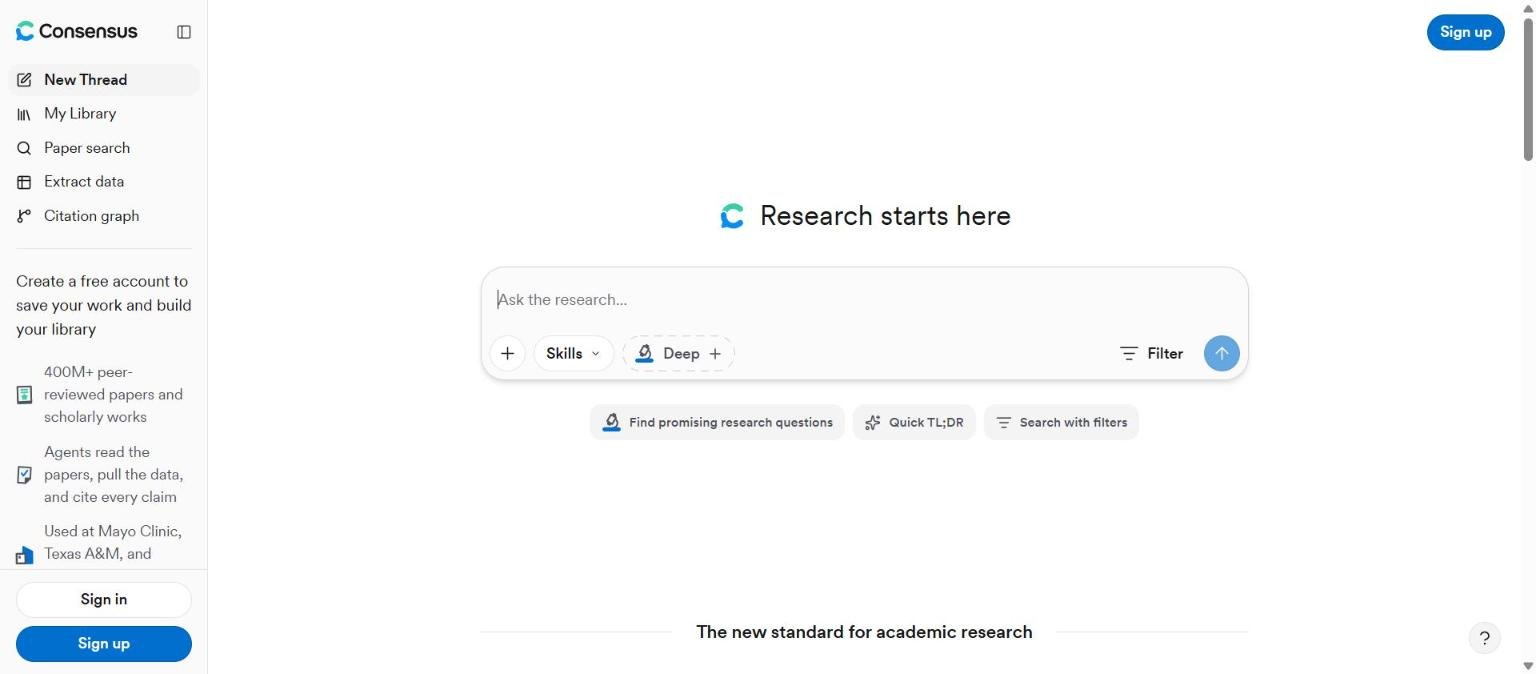
Consensus is an AI search engine for scientific research. Its homepage opens straight into a search box under the heading “Research starts here”, with a sidebar that lists New Thread, My Library, Paper search, Extract data and Citation graph. The pitch is simple: ask a research question, get an answer built from papers, and see the citations behind it.
This guide collects what Consensus says about itself on its homepage, pricing page and a technical blog post, and sets out the limits you should keep in mind. It is written for students, researchers, clinicians and curious readers who want to know whether a paid plan is worth it, and it avoids any claims we could not source.
How we researched this: we did not run hands-on tests for this article. It is based on the vendor’s own documentation and public sources, checked on 14 November 2026. Features and prices change, so confirm details on the vendor’s site before you buy.
Key takeaways
- Consensus retrieves papers first and then uses AI to summarise them, and says every response includes citations.
- The vendor claims a corpus of over 400 million scholarly sources, though a related post on its site cites a different figure, so treat corpus size as approximate.
- On 14 November 2026 the pricing page showed Free, Pro ($12 per month billed annually) and Deep ($45 per month billed annually) individual plans, plus a Team and Enterprise tab.
- The vendor itself says a model can still misread a paper and recommends reading the source material.
- Best for quick, cited orientation in a topic; less suited to replacing a careful reading of the papers.
What it is and who makes it
An answer engine limited to research papers
Consensus describes itself as an AI search engine for scientific research. A June 2025 post on its blog says it retrieves relevant papers first, then uses AI to summarise them, and that “every response includes citations”. That order matters: the summary is meant to come from papers it found, not from a model recalling facts from memory.
Where its papers come from
The same post says the corpus covers over 400 million scholarly sources, mostly peer-reviewed journal articles with some conference papers and preprints. Inputs named include Semantic Scholar, OpenAlex, its own web crawl and direct partnerships with academic publishers for full-text access. The post says it has partnerships with 6 of the 12 largest publishers and covers nearly all high-impact journals and all of PubMed. These are vendor claims. A related article on the site mentions over 200 million papers, so the number is not consistent across its own pages.
Who makes it
The pages we read did not give company details in the text we captured, so we do not state the operator. Check the about and terms pages before you subscribe for a team.
Pricing and homepage details below were read on 14 November 2026. The blog post is dated 23 June 2025, so some technical details may have moved on.
Who it is for
Students
The pricing page lists a discount of up to 40% off for students and faculty with a valid school email. The free plan gives basic paper search, which is enough for finding relevant papers to read. Our shortlist guide for students choosing AI tools covers how to weigh this against other options.
Researchers and clinicians
The Deep plan is described as being for researchers or clinicians who conduct frequent literature reviews. The same discount page mentions US healthcare professionals with a valid NPI number.
Teams and organisations
The pricing page has a separate Team and Enterprise tab, which we did not read in detail. Consensus also links pages for universities and for organisations.
Writers and analysts
Anyone who needs a fast sense of what the literature says on a question, with citations to follow up, may find it useful. The vendor warns against relying on summaries alone.
Who should look elsewhere
If your task is systematic data extraction at scale, compare it with an extraction-focused tool. If you need to keep answers grounded only in your own documents, a source-grounded notebook may fit better. See our comparison of Elicit, Consensus and Scite.
Core features
Search with an AI-written answer
You type a research question into a box and Consensus returns a synthesis built on papers it retrieved. The input box includes Skills, a Deep option and a Filter button, and quick starters such as “Find promising research questions”, “Quick TL;DR” and “Search with filters”.
Paper search
The sidebar includes a Paper search tool. The free plan lists “basic paper search” for free, without any AI analysis.
Extract data
An Extract data item appears in the sidebar. We could not read its detail pages, but the homepage text says agents read the papers, pull the data and cite every claim.
Citation graph
Citation graph is another sidebar tool. The Pro and Deep plans list unlimited access to every research tool, including search, analysis, citation graph and more.
My Library
My Library lets signed-in users save their work. The free sign-up prompt says “Create a free account to save your work and build your library”.
Single-paper features
The blog post names Ask Paper and Study Snapshot for analysing a single paper.
Multi-paper synthesis
The same post names Pro Analysis and the Consensus Meter for synthesising many papers. The post does not explain what the Meter outputs or how it is calculated, so we cannot describe the method.
Skills and filters
The input box offers a Skills menu and a Filter button. We could not open them, so we cannot list what each skill or filter does. The presence of filters suggests you can narrow a search by criteria such as study type or date, but check the live product before relying on that.
Study design and quality signals
The ranking description mentions recency, citation count and journal reputation as quality signals. A customer quote on the pricing page also credits the product with highlighting relevant papers and identifying their study designs. That is a customer testimonial, not a vendor specification, so treat it as an example of how some users describe it.
Newer or advanced features and integrations
Deep reviews
The plans meter “Deep reviews”, described as more comprehensive and thorough literature reviews of many studies. Free allows up to 3 per month, Pro 15 per month and Deep 200 per month.
API and MCP usage
Every individual plan lists API and MCP usage: a trial amount on Free, 5x on Pro and 20x on Deep, with additional usage at $0.05 per credit on the paid plans. MCP is the protocol that lets AI assistants call external tools, so this suggests Consensus can be used from other AI tools.
How retrieval works
The blog post describes hybrid search over titles and abstracts, combining semantic embeddings with BM25 keyword matching. The top 1,500 papers are re-ranked using relevance, recency, citation count and journal reputation, then a larger model re-scores the top 20. If you want background on the models involved, see what is a large language model.
Models used
The post says commercial models, with OpenAI named, handle general summarisation, while fine-tuned open-source models handle domain-specific features such as the Consensus Meter.
Checker models
The vendor says checker models verify paper relevance before summarising, and that the product reports when it finds no relevant information. We cannot verify how well these checks work.
Pricing and plans
Checked on 14 November 2026, with the page set to annual billing. We did not see monthly prices, so we cannot state them. Confirm on the live pricing page.
| Plan | Price shown (annual billing) | Listed limits and features |
|---|---|---|
| Free | $0 per month | Basic paper search; 10 Pro messages per month; up to 3 Deep reviews per month; API and MCP usage to try it out |
| Pro | $12 per month ($144 annually, saving $96 per year) | Unlimited Pro messages; 15 Deep reviews per month; unlimited access to every research tool; 5x API and MCP usage |
| Deep | $45 per month ($540 annually, saving $240 per year) | Everything in Pro; 200 Deep reviews per month; 20x API and MCP usage |
| Team and Enterprise | Not read | A separate tab exists; we did not capture details |
Extra API and MCP usage on Pro and Deep is listed at $0.05 per credit. The page also offers a discount of up to 40% for students and faculty with a valid school email and for US healthcare professionals with a valid NPI number. The Free plan notes “without any AI analysis”, which tells you the paid tiers are where the AI-written answers live. For a framework on weighing these limits, see how to read an AI tool pricing page.
Retrieval and AI features at a glance
The table summarises how the vendor’s June 2025 blog post describes the pipeline and features.
| Stage or feature | What the vendor says |
|---|---|
| Broad search | Hybrid search over titles and abstracts, combining semantic embeddings and BM25 keyword matching |
| Quality refinement | Top 1,500 papers re-ranked using relevance, recency, citation count and journal reputation |
| Final ranking | A larger model re-scores the top 20 papers for precision |
| Single-paper analysis | Ask Paper and Study Snapshot |
| Multi-paper synthesis | Pro Analysis and the Consensus Meter |
| Privacy statement | Customer data is not used to train systems or shared with third parties |
Strengths
Citations in every answer
The vendor says every response includes citations. That makes it possible to trace a claim to a paper, which is the main safeguard against invented facts.
A clear retrieval design
The blog post explains a layered process that mixes semantic and keyword search with quality signals. Few vendors describe their ranking this openly.
Simple interface
The homepage is a single search box with a small set of tools in the sidebar. That is easy for new users to grasp.
A free tier and student pricing
The free plan allows basic search and some Pro messages, and the student and faculty discount lowers the barrier further.
Fits into other AI tools
API and MCP usage on all individual plans suggests a way to bring papers into other assistants.
Weaknesses and limits
Corpus size is stated inconsistently
Its own posts cite different numbers, 200 million and 400 million, so we cannot give a single dependable figure. Coverage of your specific field is worth checking directly.
The vendor admits summaries can be wrong
The blog post says a model can still misinterpret a paper and summarise it incorrectly, and recommends reading the source material. It also claims that only this type of error is possible because sources come from the database. That claim is the vendor’s own and we did not test it. Our guide to AI hallucinations explains why checking matters.
Limited detail on the Meter
The post does not explain what the Consensus Meter outputs or how it is calculated. If you plan to cite its verdicts, ask for methodology first.
Metered Deep reviews and Pro messages
The free plan caps Pro messages at 10 per month and Deep reviews at 3, so serious use needs a paid plan.
Monthly price not confirmed
We saw annual billing prices only. Anyone who prefers monthly billing should check the live page.
Testimonials are not evidence
The pricing page carries user quotes and a claim that over 5 million researchers, students and clinicians trust Consensus. Those are marketing statements. They do not tell you about accuracy, so rely on the cited papers rather than on popularity.
Context is limited to the corpus
Consensus answers from papers, not from reports, regulations, company filings or news. If your question needs those sources, you will need another tool or a manual search.
Privacy, data handling and security
The June 2025 blog post says Consensus does not use customer data to train its systems and does not share it with third parties. That is a vendor statement in a blog post rather than a contract, so check the privacy policy and terms for your account type before uploading anything sensitive. We could not confirm retention periods, data location or security certifications from the pages we read.
- Do not paste confidential or unpublished data into any search box unless the terms allow it.
- Ask whether queries and saved libraries are retained and for how long.
- For organisations, ask about team controls on the Team and Enterprise tab.
Our guide on protecting company data when using AI tools gives a longer checklist.
How it compares
Research tools split the job differently. The table uses only points documented on each vendor’s pages that we read on 14 November 2026.
| Tool | Main job | Documented points |
|---|---|---|
| Consensus | Cited answers from a research corpus | 400M+ claimed sources; Free, Pro and Deep plans; Deep reviews; Citation graph |
| Elicit | Extraction and systematic review | Says it searches about 138M papers; Systematic Review workflow; extraction tables |
| Scite | Citation context | Smart Citations show supporting, contrasting or mentioning citations; Reference Check; Assistant |
| NotebookLM (now Gemini Notebook) | Answers from your own uploaded sources | Source limits by plan; Audio and Video Overviews; reports, flashcards and quizzes |
For general web research rather than papers, our piece on Perplexity versus Google for research may help. If you keep reading lists, see how to use AI for research notes and reading lists.
Getting started
- Open the homepage and try a free search on a question where you already know the field.
- Click through to at least three cited papers and compare the paper with the summary.
- Try a Deep review on the free allowance to see how a larger review looks.
- Save a few results to My Library by creating a free account.
- If you hit the limits, check the live pricing page for annual and monthly rates and any student discount.
A fuller checklist is in how to check AI output for mistakes.
Frequently asked questions
Is Consensus free?
Yes, in part. The Free plan lists basic paper search, 10 Pro messages per month, up to 3 Deep reviews per month and trial API and MCP usage. It states that basic search comes without any AI analysis.
How much does Consensus cost?
On 14 November 2026 the page showed Pro at $12 per month ($144 annually) and Deep at $45 per month ($540 annually) on annual billing. We did not see monthly prices.
How many papers does Consensus cover?
The vendor claims over 400 million scholarly sources in a June 2025 post, but another post on its site mentions over 200 million, so the figure is inconsistent.
Does Consensus make things up?
The vendor says every answer cites papers from its database and that only misreading a paper is possible. It also says models can still summarise a paper incorrectly. Read the sources.
Does Consensus train on my data?
The blog post says it does not use customer data to train its systems or share it with third parties. Check the privacy policy for details.
Is there a student discount?
The pricing page offers up to 40% off for students and faculty with a valid school email and for US healthcare professionals with a valid NPI number.
Can I use Consensus inside other AI tools?
The plans list API and MCP usage, which suggests yes. We did not read the technical documentation, so check it first.
Is Consensus the same as a general chatbot?
No. The vendor describes it as a search engine for scientific research that retrieves papers first and summarises them. A general chatbot answers from broader training data and may not cite papers at all.
Conclusion
Consensus is a focused way to get cited, paper-based answers to research questions. Its strengths are the retrieve-then-summarise design, visible citations, a simple interface and a usable free tier. Its limits are the ones the vendor itself names: summaries can misread a paper, and the Consensus Meter method is not explained in the sources we read.
Best for: quick, cited orientation in an unfamiliar topic. Think twice if: you need audited extraction or cannot verify against the papers. Start free, read the cited sources, and confirm current prices before paying.
Sources
- Consensus homepage, accessed 14 November 2026
- Consensus pricing page, accessed 14 November 2026
- Consensus blog: How it Works and Consensus FAQs, 23 June 2025, accessed 14 November 2026