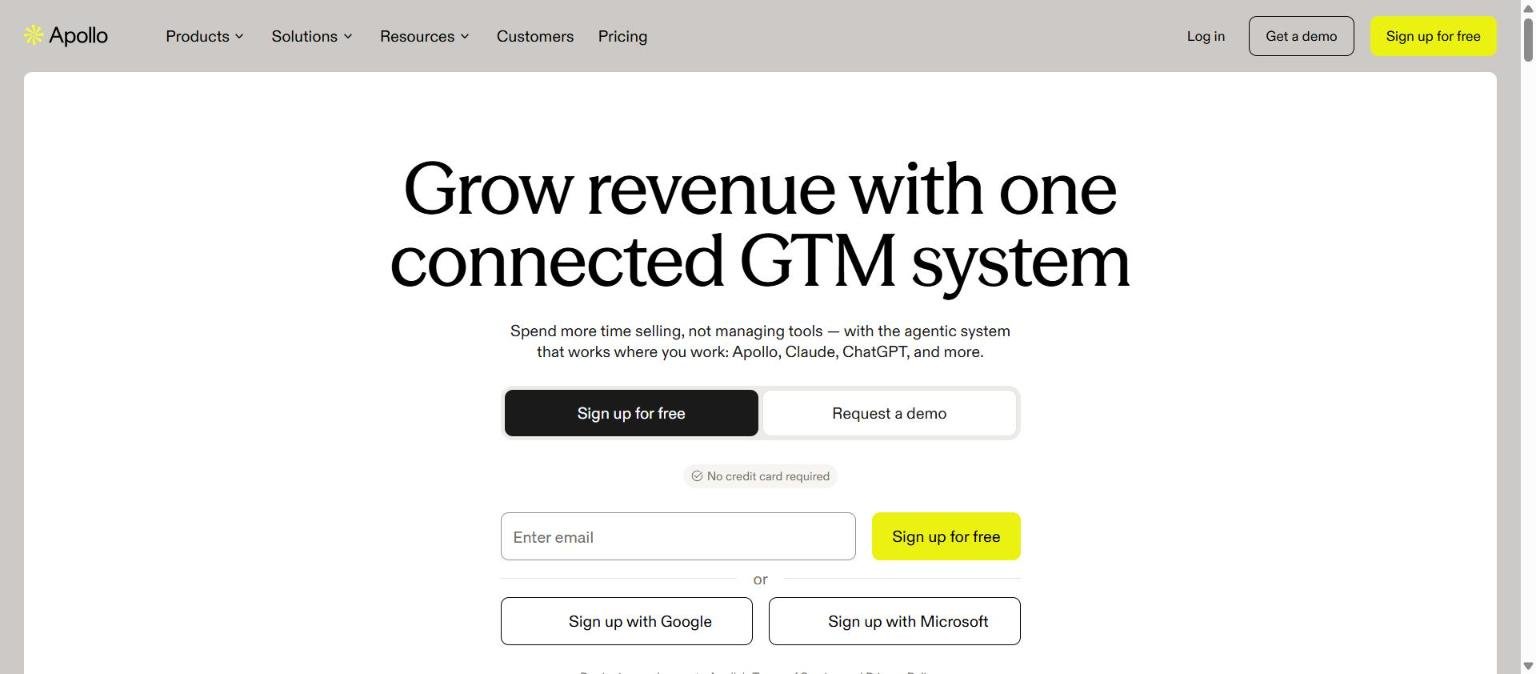
Apollo is a sales prospecting and outreach platform. Its homepage headline is “Grow revenue with one connected GTM system,” where GTM means go to market, and it combines a database of business contacts, tools to email and call prospects, deal tracking, and AI agents that research accounts, build lists and write outreach.
This guide sets out what Apollo’s own homepage and pricing page say about features, plans, credits and limits, as read on 14 November 2026, and flags what we could not confirm. For a head to head view of two prospecting approaches, see Apollo versus Clay for prospecting, and for general method see how to choose an AI tool.
How we researched this: we did not run hands-on tests for this article. It is based on the vendor’s own documentation and public sources, checked on 14 November 2026. Features and prices change, so confirm details on the vendor’s site before you buy.
Key takeaways
- Apollo’s homepage describes three layers, Data, Intelligence and Execution, and claims 240M plus contacts, 30M plus accounts and over 600,000 companies using it (vendor figures).
- The pricing page, read on 14 November 2026, lists Free at $0, Basic at $49, Professional at $79 and Organization at $119 per seat per month on annual billing, with a minimum of 3 seats on Organization.
- Plans are driven by credits: 900 a year on Free, then 30,000, 48,000 and 72,000 per seat per year. An email costs 1 credit and a phone number costs 8, and unused credits do not roll over.
- The vendor lists SOC 2 Type II and ISO 27001 among its certifications and says it provides tools for GDPR, CAN-SPAM and DNC compliance. How you use prospect data is still your legal responsibility.
- We did not run hands-on tests, so we cannot comment on data accuracy or deliverability. Test with a small list before you commit.
What Apollo is and who makes it
Apollo is the product at apollo.io, and the pages carry the footer “Apollo © 2026.” The homepage title calls it the AI GTM system for go-to-market teams. It describes three layers. Data is your own data, Apollo’s proprietary data and third-party signals. Intelligence is where agents learn your business, research accounts, prioritise leads, write outreach and book meetings. Execution is where you launch outreach from Apollo’s Workspace or in tools you already use.
The homepage claims 240M plus contacts and 30M plus accounts of B2B data, and says over 600,000 companies use Apollo. The pricing page shows a rating of 4.7 out of 5 based on 9,690 reviews, along with the words “GDPR Compliant.” Those are the vendor’s own figures and we have not verified them. We did not find a company history page in the text we read, so we do not say who founded or runs Apollo.
Named product parts
The homepage names several parts: Workspace for prospecting, outreach and dialing, Apollo Anywhere to work from your CRM, ChatGPT, Claude, Gmail or browser, Builder Studio, Apollo Profile as a unified view of a contact or account, the GTM Harness that trains agents on your ideal customer profile, an AI Context Center, a Chrome extension, a Parallel Dialer and an Apollo MCP. The homepage also states 200 plus integrations.
Who Apollo is for
The pricing FAQ gives guidance by plan. Free is for exploring Apollo or very light usage, and it is described as good for founders and early-stage teams. Basic is for individual sellers doing regular outbound, with email sequencing and core integrations. Professional is for full-time reps who need higher credit limits, AI features, call recording and advanced CRM integrations. Custom is for teams needing custom volumes, SSO, advanced security and dedicated support.
| Reader | What the pricing page suggests |
|---|---|
| Founder testing outbound | Free plan with 900 credits per seat per year, 2 sequences |
| Individual seller | Basic at $49 per seat per month, unlimited sequences, 30,000 credits per year |
| Full-time sales team | Professional at $79, A/Z testing, call recordings and AI insights up to 4,000 minutes |
| Larger or multi-team organisation | Organization at $119 per seat, minimum 3 seats, 8,000 call minutes, 12 intent topics |
The FAQ says Apollo works with large enterprises and names companies such as Intel, AT&T, Adobe, SAP and Shopify. That is a vendor claim. If you are deciding whether a prospecting platform belongs in your stack, see how to choose an AI tool.
Core features
Contact and account data
Apollo’s data is the base of the product. The pricing page lists contact and account data on every plan, with basic filters on Free and advanced filters from Basic. Record selection limits cap how many records you can pick in one action: 25 on Free, 1,000 on Basic, 2,500 on Professional and 10,000 on Organization. We did not read how the data is sourced, so we cannot assess accuracy.
Sequences and AI writing
Sequences are multi-step outreach campaigns. Free allows 2 sequences per team, and Basic and above list unlimited sequences, with A/Z testing from Professional. AI writing allowances are 5,000 words per month on Free, 250,000 on Basic, 800,000 on Professional and 1,000,000 on Organization.
Email sending and mailboxes
The pricing FAQ says email campaigns are included on every account, and on free plans you can connect Gmail accounts only, while paid plans let you connect Microsoft Office or other providers. Daily sends are 250 on Free and Basic and unlimited on Professional and Organization, with the unlimited label subject to a fair use policy.
Deliverability tools
The homepage says domain warming, inbox rotation and reputation monitoring help keep outreach landing where it should. The pricing page lists a Deliverability Suite and email warmup from Basic. We cannot judge how well it works.
Dialer and call recording
Basic and above list a US dialer, with credits applying, at 1 credit per 30 seconds. Call recording is 150 minutes on Free and Basic, 4,000 minutes on Professional and 8,000 on Organization, along with AI insights from Professional.
Deal management, meetings and analytics
Lead and deal management, a meeting scheduler, pre-meeting AI insights and analytics are listed across plans, with 1 meeting event on Free, 3 on Basic, 6 on Professional and unlimited on Organization.
Newer and advanced features and integrations
AI Assistant and AI Research
The AI Assistant is labelled introductory and is capped at 5 chats of 10 messages each on Free. AI Research costs 1 credit per run, according to the credit table. AI Lead Scoring starts on Professional.
Agents and the AI Context Center
The homepage says agents research, build lists, write outreach, follow up and book meetings, prompting you at key moments. An AI Context Center trains agents on your ideal customer profile and product, and agent memory is said to sharpen over time. We did not read documentation on how much an agent does without approval, so ask before you let one send mail.
Apollo MCP and working from Claude or ChatGPT
The homepage names an Apollo MCP and says the system works where you work, including Claude and ChatGPT. The pricing FAQ says API access is available on Custom plans, while the plan list on the same page shows API Access under Free and API Enrichment on paid plans, so confirm exactly what each plan allows.
Waterfall enrichment and CRM integrations
Waterfall enrichment checks multiple sources to fill gaps in a record, and it is listed from Basic. CRM integrations are listed from Basic. The FAQ names Salesforce, HubSpot, Outreach, SalesLoft, Marketo, Sendgrid and LinkedIn among integrations.
Website visitors and intent
Website visitor identification covers 20 companies a month on Free and 100 on paid plans, according to the plan list. Intent topics rise from 1 on Free to 6 on Basic and Professional and 12 on Organization. Intent signals are the vendor’s estimate of buying interest, so treat them as leads to verify.
Pricing and plans
Checked on 14 November 2026 on the official pricing page (apollo.io/pricing). Prices exclude tax. The page has an annual billing option labelled “save 24%” and a monthly billing option. The figures below are the annual-billing per seat prices, and we did not record the monthly figures, so we cannot confirm them. The page says features and pricing are introductory and may change. See how to read an AI tool’s pricing page.
| Plan | Price per seat per month (annual billing) | Credits per seat per year | Trial |
|---|---|---|---|
| Free | $0 | 900, granted monthly | Not applicable |
| Basic | $49 | 30,000, granted upfront | 14-day trial |
| Professional | $79 | 48,000, granted upfront | 14-day trial |
| Organization | $119, minimum 3 seats | 72,000, granted upfront | Talk to Sales |
| Limit | Free | Basic | Professional | Organization |
|---|---|---|---|---|
| Sequences | 2 per team | Unlimited | Unlimited plus A/Z testing | Unlimited plus A/Z testing |
| AI writing words per month | 5,000 | 250,000 | 800,000 | 1,000,000 |
| Mailboxes per user | 1 | 1 | Unlimited Google and Microsoft plus 5 SMTP | Unlimited Google and Microsoft plus 15 SMTP |
| Daily email sends | 250 | 250 | Unlimited | Unlimited |
| Automated workflows | 2 per team | 5 per team | 50 per team | 500 per team |
| Record selection limit | 25 | 1,000 | 2,500 | 10,000 |
| Call recording minutes | 150 | 150 | 4,000 | 8,000 |
Credits
Credits are the currency inside Apollo. An email costs 1 credit, a phone number costs 8, enrichment costs 1 to 8, an AI Research run costs 1, and the US dialer costs 1 credit per 30 seconds. International dialing varies by region. Credits are pooled across the team and granted upfront each billing cycle on paid plans. Unused credits expire at the end of the cycle and do not roll over, and that applies to purchased add-on credits as well.
Add-ons
The page lists an Inbound add-on at $119 for Essentials or $639 for Max per team per month, billed annually, and an Advanced Dialer add-on at $119 per team per month, billed annually. Extra credits can be bought with a slider, are charged immediately, and renew automatically until you set the slider back to zero.
Billing rules from the FAQ
All seats on an account must be on the same plan. Upgrades take effect immediately, downgrades also take effect immediately and the page says refunds are not issued for unused time. Cancellation takes effect at the end of the plan term. Switching from annual to monthly means waiting for the annual plan to expire. The trial includes 75 credits and access to most features in the selected plan. The page says that after a trial you can move to a free Starter plan, which the plan table calls Free, so the naming differs on the page.
Strengths
A free plan and a trial
The Free plan has no time limit according to the FAQ, and paid plans offer a 14-day trial, so you can look before you pay.
Prospecting and outreach in one account
Data, sequences, a dialer, call recording, deal tracking and analytics are in one product, which reduces the number of tools to join up.
Transparent credit costs
The page lists what an email, a phone number and an AI research run cost in credits, and how credits are granted and expire. That is easier to model than vague “usage” language.
Usage controls for admins
The FAQ says admins can track credit usage by date range, credit type and user, and set per-user caps, which helps avoid one rep using the pool.
Security and compliance claims are specific
The homepage lists SOC 2 Type II and ISO 27001 for enterprise, and names GDPR, CCPA, CPRA, EU-US DPF, PCI DSS and CASA Tier 2 among badges. Ask for the reports if these matter to you.
Weaknesses and limits
Credits can run out
Phone numbers cost 8 credits each. At 30,000 credits per seat per year on Basic, a seat that mostly buys phone numbers would get far fewer contacts than one that buys emails. Unused credits do not roll over.
Plan rules are rigid
All seats share a plan, Organization has a minimum of 3 seats, and annual to monthly switches require waiting out the term. Downgrades do not refund unused time.
Mixed messages on the page
The FAQ says API access is on Custom plans, but the plan list shows API items on paid plans and Free. The free tier is called both Free and Starter. We could not resolve these, so confirm directly.
Introductory pricing
The page says features and pricing are introductory and may change, so plan for movement.
Outreach carries legal and reputation risk
Apollo provides compliance tools, but the rules for emailing and calling prospects depend on where they are and what you send. This is general information, not legal advice. Check your own obligations.
Data accuracy is a vendor claim
The vendor’s customer quotes mention better deliverability and more meetings, but they are selected by the vendor. Test with a small list and see how to check AI output for mistakes before AI-written outreach goes out.
Privacy, data handling and security
The homepage says enterprise security and certifications include SOC 2 Type II and ISO 27001, and it lists GDPR, SOC 2, CCPA, ISO/IEC 27001, CASA Tier 2, CPRA, EU-US DPF and PCI DSS as badges. It says the tools to comply with GDPR, CAN-SPAM, DNC and regional rules are ready to go and that agents have built-in support for consent and opt-out rules. The footer links to a Privacy Policy and a Privacy Center, and a “Don’t Sell My Info” link. We did not read those documents, so we cannot say how long data is kept, where it is stored or whether your content is used to train models. The pricing FAQ says plan data is for internal business use only and reselling it or building products on it needs a separate agreement. Prospect data is personal data, so see our guide to protecting company data and take legal advice on outreach in your markets.
How it compares with alternatives
We did not research a competing prospecting vendor’s pages for this guide, so we do not tabulate rival prices. Our older comparison, Apollo versus Clay, covers one rival. The table below lists what to compare, with what Apollo documents for each item.
| What to compare | What Apollo documents | What to ask a rival |
|---|---|---|
| Data source and size | 240M plus contacts, 30M plus accounts, regular refresh (vendor claim) | How is data sourced, and how is accuracy measured? |
| Pricing unit | Per seat, with credits per seat per year | Per seat, per credit or per record? |
| Cost of a phone number | 8 credits | What does a verified phone cost? |
| Rollover | Credits expire each cycle | Do credits roll over? |
| Agents and approval | Agents research, write and follow up, prompting you at key moments | What runs without a human check? |
| Security evidence | SOC 2 Type II and ISO 27001 named | Which reports can you see? |
For workflow automation that sits between tools, see our Zapier guide and Zapier, Make and n8n: how to decide, and for a method that works for any pair of tools see how to compare AI tools side by side fairly.
Questions to ask before you buy
How many credits will my team really use?
Use the calculator the pricing page links to, and then model emails at 1 credit and phone numbers at 8 against your list sizes.
Which email provider do I need to connect?
Free accounts connect Gmail only, and paid plans allow Microsoft and other providers. Check the mailbox limits for your plan.
What happens at renewal?
The page says pricing is introductory. Ask what the renewal price will be and how seats are billed if you add people mid-term.
What do agents do without approval?
Test the agents in a sandbox with a small list and review every message before sending.
Getting started
- Write down your ideal customer profile and how many prospects you need each month.
- Sign up for the Free plan or a 14-day trial on apollo.io, which the page says needs no credit card for sign-up.
- Connect one mailbox and one CRM, and check which providers your plan supports.
- Build a small list, buy a few emails and phone numbers, and watch how many credits they use.
- Run a short sequence to a small, relevant audience, and check deliverability before scaling.
- Follow how to test an AI tool before you pay for it, then choose a plan and billing period.
Frequently asked questions
How much does Apollo cost?
On 14 November 2026 the pricing page showed Free at $0, Basic at $49, Professional at $79 and Organization at $119 per seat per month on annual billing, with a 3 seat minimum on Organization. We did not record monthly billing prices.
Is there a free plan?
Yes. The Free plan lists 900 credits per seat per year, granted monthly, and the FAQ says it has no time limit.
What is in the free trial?
The FAQ says the trial includes 75 credits and access to most features of the plan you selected, with some trial limits.
What is a credit?
Credits are the currency for emails (1), phone numbers (8), enrichment (1 to 8), AI research runs (1) and dialing (1 per 30 seconds in the US).
Do unused credits roll over?
No. The FAQ says unused credits expire at the end of each billing cycle, including purchased add-on credits.
Can I mix plan levels in one team?
No. The FAQ says all seats on an account are on the same plan.
Does Apollo work with Claude or ChatGPT?
The homepage says the agentic system works where you work, naming Claude and ChatGPT, and lists an Apollo MCP. We did not read the setup documentation.
Conclusion
Apollo presents itself as a connected system for prospecting, outreach and deal work, with a free plan, three paid per seat plans from $49 to $119 on annual billing, and a credit model that limits how much data you can buy. The documented strengths are the free option, clear credit costs and named security certifications. The documented limits are credit expiry, shared plan rules and a few inconsistent details on the pricing page. We did not test it, so judge data quality and deliverability on a small pilot.
When you weigh it against another approach, read Apollo versus Clay and our side by side method, and confirm every price on the vendor page.
Sources
- Apollo homepage, accessed 14 November 2026
- Apollo pricing page, accessed 14 November 2026